The 60-Hour Task Your Business Repeats Every Year Without Realising It
Every business runs on repetitive tasks nobody notices — until you add them up. Here's how we automated employee birthday emails using n8n, recovered 60+ hours a year, and discovered a template for transforming dozens of other business processes.
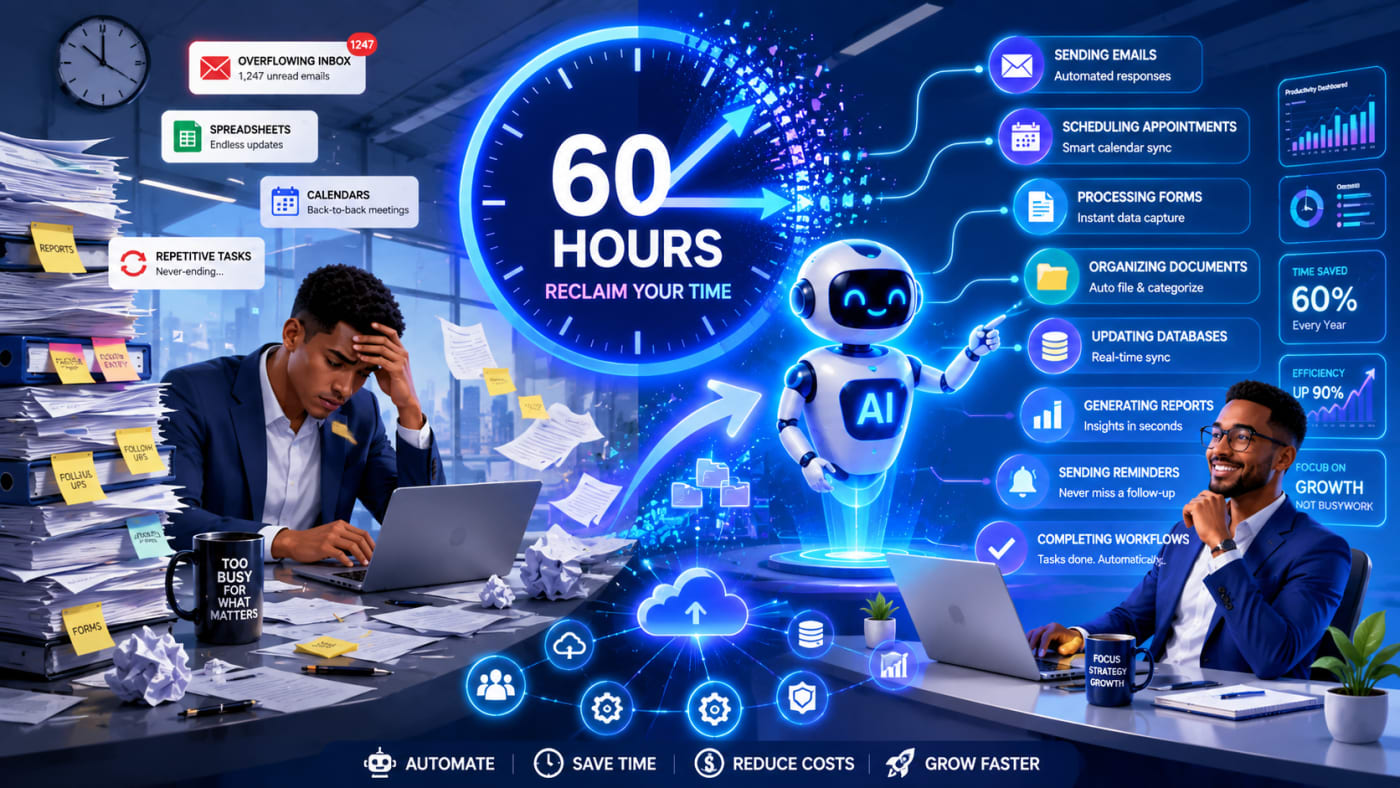
Every business runs on dozens of small, repetitive tasks that nobody really notices. On their own, each one feels harmless — five minutes here, ten minutes there. But quietly, in the background, those minutes stack into hours, and those hours stack into days of paid time spent on work that adds no real growth to your business.
One of the clearest examples I've seen is something as simple as remembering employee birthdays. It sounds trivial. Yet when we mapped it out for a client, that one small courtesy was costing them more than 60 hours of staff time every single year — and it was still being forgotten half the time. So we automated it.
Why Remembering Birthdays Actually Matters
Employee recognition is one of the most consistently underrated drivers of engagement, loyalty, and retention. People don't just want a salary — they want to feel seen. A birthday message is a small thing, but small things send big signals. When an employee receives a warm, personalized message, it quietly communicates: you are not just a number here. Now flip it: when a birthday is forgotten, the silence is loud. An employee who watches colleagues get celebrated while their own day passes unnoticed feels overlooked — and that sting chips away at morale over time. Inconsistency is often worse than doing nothing, because it feels personal. This was never really about birthdays. It's about consistency in employee experience — and consistency is exactly what humans are bad at and automation is brilliant at.
The Hidden Cost of Doing It Manually
Suppose an HR officer spends just 10 minutes a day checking the birthday list and sending messages. Ten minutes a day across 260 working days adds up to more than 43 hours annually. Factor in double-checking, chasing correct email addresses, and fixing messages sent to the wrong person, and it comfortably crosses 60 hours — well over a full working week — spent on a task a computer can do in seconds. Beyond the time, there are hidden costs that rarely get counted: forgotten birthdays when someone is on leave, human errors like wrong names or wrong recipients, inconsistency where some months everyone is celebrated and others nobody is, and the opportunity cost — every minute spent here is a minute not spent growing the business.
The Automated Solution: Set It Once, Trust It Forever
Instead of relying on a human to remember, check, and send every day, we built an automated workflow that handles the entire process on its own — accurately, consistently, and invisibly. We built it using n8n, a powerful automation platform that connects different apps and services and lets them talk to each other. Think of n8n as a digital employee who never sleeps, never forgets, and never makes a careless mistake. Once it's set up, the manual work drops to zero. The business owner or HR manager configures it a single time, and from that day forward, every employee's birthday is remembered and celebrated automatically.
How the Workflow Actually Works — In Plain English
Every day at a set time, the workflow wakes up on its own. It fetches the latest employee records from your database or system. It checks whether anyone has a birthday today. If yes, it automatically composes and sends a warm, personalized 'Happy Birthday' email addressed to each person by name, from your company's own email account. If nobody has a birthday, it simply finishes and quietly waits for tomorrow. From the outside, employees just experience a company that reliably remembers them. Behind the scenes, not a single human minute was spent.
The Technology Behind It — Explained Simply
n8n is the engine that ties all the steps together and connects to almost any app your business already uses. A Scheduled Trigger acts as the daily alarm clock, making the workflow run hands-free at the exact time you choose. An HTTP Request fetches up-to-date employee records from your system. Conditional Logic is the decision-maker — it asks whether today matches anyone's birthday, and acts only when the answer is yes. Finally, Gmail Integration composes and delivers the personalized message from your company account. Individually, these are simple building blocks. Combined, they replace an entire recurring human task with a system that runs flawlessly, every day, in the background.
What Other Business Processes Can Be Automated?
Once you understand this pattern — a trigger, some data, a decision, and an action — you start seeing automatable tasks everywhere. The same approach can handle lead capture and pipeline updates, customer onboarding email sequences, invoice reminders, appointment confirmations, CRM data entry, new employee onboarding, automated report generation, and AI-powered customer support. Each of these is a recurring drain on someone's time right now. Each one can be handed to a workflow that does it faster, more reliably, and without complaint. Multiply the savings across even five such processes and you're reclaiming weeks of productive time every year.
Why Automation Is Becoming Essential for Modern Businesses
A few years ago, business automation felt like a luxury reserved for large corporations with big budgets. Today, platforms like n8n have made the same capabilities available to small and medium businesses — including growing companies right here in Nigeria and across Africa. Businesses that embrace automation respond to customers faster, make fewer costly errors, free their teams for high-value creative work, and scale without simply hiring more staff to handle more manual tasks. This is what digital transformation actually looks like in practice: not a massive, intimidating project, but a series of smart decisions to let software handle what software does best.
Where to Start: Small Wins First
Don't wait until you're ready for a giant AI project. Start with the small, annoying, repetitive tasks — the birthday emails of your business. Pick one process that eats time, follows a predictable pattern, and drains focus from real work. Automate that one thing. Watch it run flawlessly for a few weeks. You'll not only reclaim those hours — you'll start seeing your entire operation through new eyes, spotting opportunity after opportunity to work smarter. Big transformations are built from small automated wins. The birthday workflow was never really about birthdays — it was proof that the repetitive work quietly stealing your team's time doesn't have to be done by hand at all.
Frequently asked questions
Do I need technical skills to use business automation?
No. That's the whole point. You describe the task you want handled, and a system like n8n runs it for you in the background. Working with an automation partner means you get the results without touching the technical side at all.
Is my data safe with this kind of automation?
Yes, when it's set up properly. The workflow only accesses the specific data it needs, through secure connections, and nothing is shared outside your systems. Good automation follows the same security standards as any trusted business software.
Can automation work with the tools my business already uses?
In most cases, yes. n8n connects with hundreds of common apps and services — email, spreadsheets, databases, CRMs, and more — so automation usually fits around your existing tools rather than replacing them.
How much time can automation really save?
It depends on the task, but even a single small process like birthday emails can recover 60+ hours a year. Automate several processes and the savings quickly add up to weeks of reclaimed time annually.
What's the best first process to automate?
Start with something small, repetitive, and predictable — invoice reminders, welcome emails, or appointment confirmations are great examples. Small wins prove the value quickly and build momentum for bigger automations.
The bottom line
So we automated it. The result: 60+ hours of staff time recovered every year, near-zero errors, and a noticeable lift in how valued employees feel — all from a system that took a fraction of that time to build once. The repetitive work quietly stealing your team's time doesn't have to be done by hand. You just need to know how to hand it over. This is the kind of work our AI agents and automation service takes off your team's plate.
At Loukama Tech Solutions, we design AI-powered automation systems that quietly handle the repetitive work draining your business — using n8n, cloud technologies, and artificial intelligence. From employee automation and invoice reminders to full customer workflows and AI customer support, we help businesses in Nigeria and worldwide save time, reduce errors, and grow without adding busywork. If you can think of even one task your team repeats over and over, there's a good chance it can be automated.