What All 40 Levels of PandaMath Actually Look Like
Parents don't really buy an app, they buy a path. Here's exactly what your child works through across all 40 PandaMath levels, from single-digit addition to multi-digit mental math.

Parents do not really buy an app. They buy a path, some assurance that if their child sticks with this for six months, they will end up somewhere better than where they started.
So here is the path, laid out honestly.
The shape of the progression
Every level in PandaMath is defined by three things: how many digits are in each number, how many rows the child must add, and which operations are involved. Difficulty rises by adjusting those three, never by simply making the timer faster.
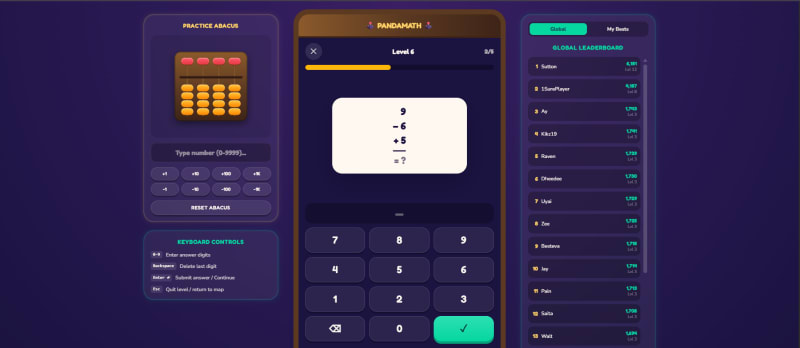
You can see this on the level map. Level 1 reads "1-dig · 2 rows · +". Level 5 reads "1-dig · 4 rows · +". Level 6 introduces "±" — the first appearance of subtraction. The child is never dropped into something unfamiliar; each step adds exactly one new demand.
Levels 1–3: the free foundation
- Level 1 — Baby Steps: single-digit addition, two rows.
- Level 2 — First Steps: single-digit addition, two rows, building fluency.
- Level 3 — Warm Up: single-digit addition, three rows.
This is the free section. The purpose is comfort, not challenge — a child should finish Level 3 feeling capable rather than tested.
Levels 4–10: more to hold in your head
- Level 4 — Add Along: three rows, consolidating.
- Level 5 — Four in a Row: four rows of single-digit addition.
- Level 6 — First Minus: subtraction arrives for the first time.
- Level 7 — Mix It Up: addition and subtraction together, four rows.
- Level 8 — Quick Mix: same demand, faster recall.
This band is where mental calculation genuinely begins. Holding four numbers and a mix of operations is beyond what most children can do on fingers — which is exactly the point. The workaround stops being viable, so the mental structure has to form.
Beyond Level 10
From here the numbers grow past single digits and the rows continue to increase. The demands compound: more digits, more rows, mixed operations, less time. By the upper levels a child is doing work that most adults would reach for a calculator to check.
This is the section almost nobody sees, because it sits behind the paywall. It is also where the actual transformation happens. The free levels show your child the method. These levels build it.
Why the leaderboard tells the same story
Look at the global leaderboard and you will see most players sitting at Level 3 with scores around 1,700. The top player, Sutton, is at Level 12 with over 6,000.
That gap is not talent. It is access. Higher levels carry more points because they demand more, so a child who progresses is rewarded twice — in skill and in score.
Every future level is included
There are 40 levels today. We are still building, and more are coming.
If you buy now, every level we add afterwards is yours at no additional cost. No upgrade fee, no second purchase, no "PandaMath 2" you have to buy separately. One payment of ₦4,000 covers the game as it is and as it becomes.
That is a deliberate commitment on our part. We would rather have parents who trust the product than parents who feel charged twice.
The bottom line
Levels 1 to 3 are free, no download, no card, no account. Play them with your child and see whether the progression suits them before you decide about the other 37.
See the level map for yourself and walk the first three levels free with your child.