Can Your Child Beat Sutton? Inside the PandaMath Leaderboard
At the top of the leaderboard right now is a player called Sutton on 6,181 points. Real scores, updating live and not one real name among them. That last part matters.

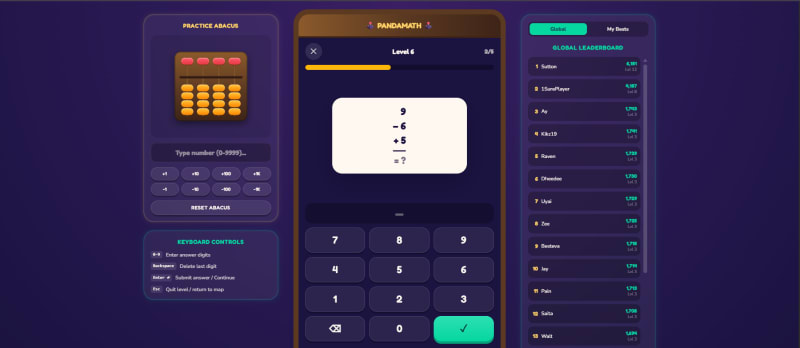
Right now, at the top of the Panda Math leaderboard, there is a player called Sutton sitting on 6,181 points at Level 12. Below Sutton there are dozens of others; Kikz19, Raven, Dheedee, Uyai, Zee, Besteva, Jay. Real children, real scores, updating live as they play.
None of them are using their real names. That is deliberate, and it is the part parents should read carefully.
Why the leaderboard exists
Getting a child to practise maths daily is the hardest part of any programme. Not the method, not the material, the showing up.
Competition solves this in a way instruction cannot. A child who will not do twenty sums because you asked will do sixty trying to overtake someone called Kikz19. The maths is identical. The motivation is completely different.
This is why the leaderboard is not decoration. It is the mechanism that turns a good method into a daily habit.
How children compete without exposing themselves
When a child starts Panda Math, they choose a nickname. That nickname is the only thing that ever appears publicly.
- No real names. A child's actual name is never displayed on the leaderboard.
- No photos. There are no profile pictures, no avatars of real people.
- No chat. Players cannot message each other. There is no direct contact between children.
- No location. Nothing indicates where a child is, what school they attend, or how old they are.
What a child sees is a nickname and a score. What another child sees of them is a nickname and a score. That is the entire social surface.
We built it this way because Nigerian parents are right to be cautious about children appearing online. A leaderboard that motivates a child is worth very little if it makes a parent uneasy about privacy.
The two leaderboards
There is a Global tab showing every player, and a My Bests tab showing your child's own scores.
That second one matters more than parents expect. Not every child is motivated by beating strangers, some find it discouraging. For those children, competing against their own previous best is the healthier target, and it produces the same daily practice without the comparison.
Both are available. Let your child use whichever one keeps them coming back.
What the levels next to each score mean
Look at the leaderboard and you will notice most players sit at Level 3. That is where the free levels end.
Sutton is at Level 12. Those higher scores come from the levels beyond the free three, where the rows increase, subtraction arrives, and multi-digit work begins. More difficulty means more points available.
So a child who unlocks the full game is not just getting more content. They are getting access to the part of the leaderboard where the real climbing happens.
Frequently asked questions
Is the PandaMath leaderboard safe for children?
Yes. Children appear only by a nickname they choose. No real names, photos, locations, schools or ages are shown, and players cannot message each other.
Why does PandaMath have a leaderboard?
Because daily practice is the hardest part of learning maths, and friendly competition is what keeps many children coming back to practise every day.
What if my child does not like competing against others?
Use the My Bests tab instead of the Global one. It shows only your child's own scores, so they can work on beating their personal best without comparing themselves to strangers.
Can children chat with each other on PandaMath?
No. There is no chat or direct contact between players. The only thing other players ever see is a nickname and a score.
The bottom line
The first three levels are free; no download, no card, no account. Your child picks a nickname, plays, and appears on the leaderboard immediately. If competing lights something up in them, you will know within one evening. That is the moment worth paying attention to.
Put your child on the leaderboard, start with the three free levels and see if competing catches.